Is Google Drive GeBüV-Compliant? The Honest Answer
Yes, technically — but 'GeBüV-compliant' is not a product you can buy. What Google Drive covers, what remains your task, and why there is no state GeBüV certification.
By Roman Brüngger — Fiduciary with a Swiss federal diploma · Founder rombro ag
As of: July 2026 · This article is not legal advice.
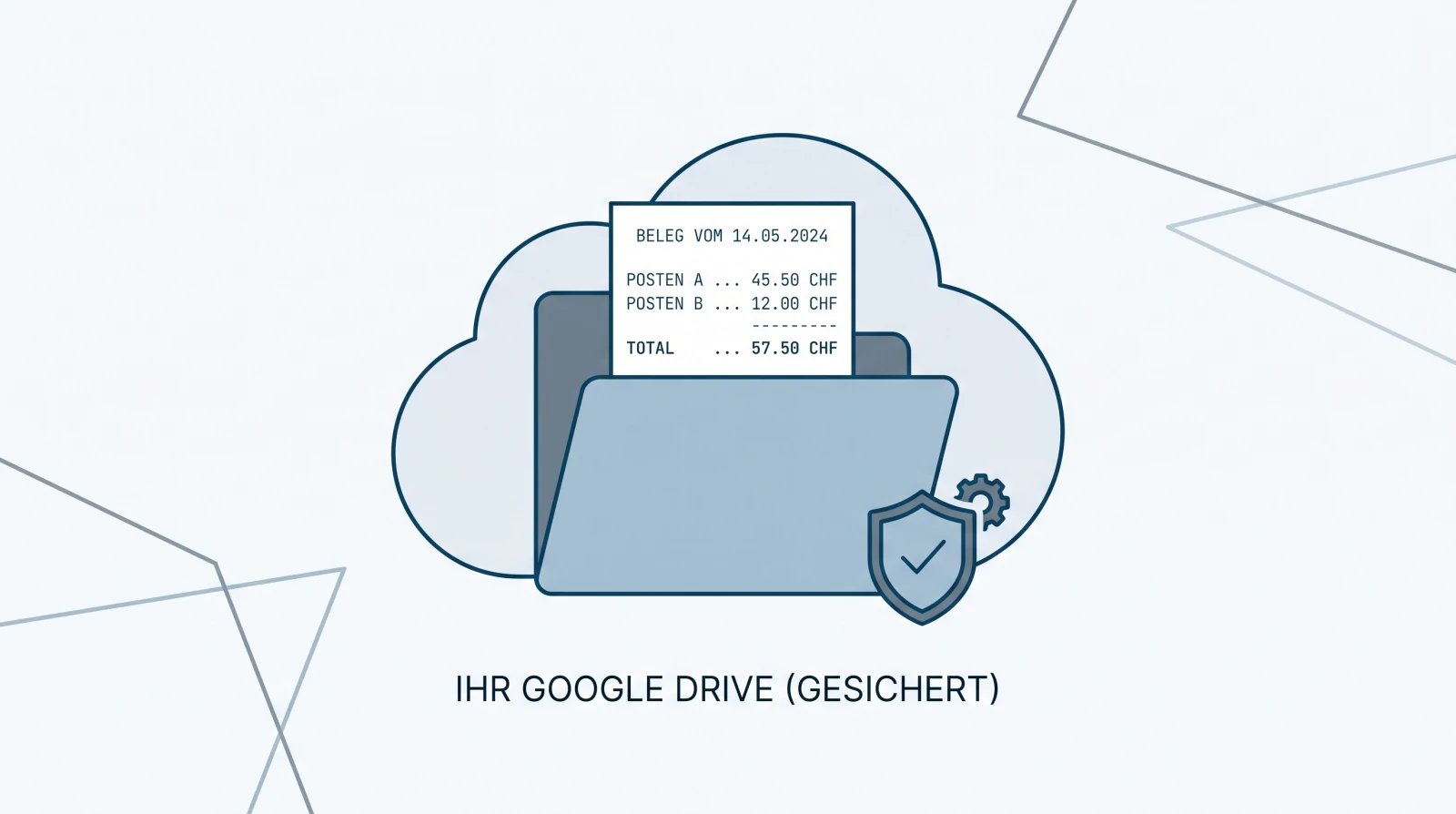
Yes — in the technical sense, and that is the whole honesty of this answer. Google Drive meets the technical requirements for keeping digital receipts in an audit-proof way, compliant with the CO, GeBüV and tax law. But “GeBüV-compliant” is not a label a product carries: audit-proof record keeping is not a product feature — it results from the system plus its orderly use. Drive brings the technical side; the procedural documentation (Art. 4 GeBüV) and the annual legibility check (Art. 10) remain your task. And a state GeBüV certification that you could buy and tick off does not exist.
You rarely hear this answer put so directly. Vendors of “audit-proof” archive software prefer to sell the fear that a generic cloud is automatically in breach of the GeBüV — that is marketing, not law. The law is technology-neutral: it demands properties, not a branded product. How you meet those properties with Google Drive is set out below; the deeper fiduciary assessment is in our manifesto on audit-proof records, the legal mechanics in the GeBüV guide.
Is Google Drive audit-proof?
In short: Google Drive meets the technical requirements for audit-proof filing — integrity, logging, availability and access protection are all there. What “audit-proof” means beyond that, however, is not a property of the software but of your filing.

The thinking error sits in the word itself. “Audit-proof” sounds like a switch you flip or buy. In fact it describes a state: receipts are unchanged, orderly, findable and traceable — for ten years. No product produces this state on its own. The most expensive archive software does not become audit-proof if nobody keeps the receipts in order; and Google Drive meets the requirements as soon as the filing runs in an orderly way.
For a specific document, the retention period calculator shows when the period ends for a given financial year.
That is also why there is no state “GeBüV certificate”: compliance hangs on your use, not on the label of the storage. The certificates that do exist (for instance from the KRM audit body) are private-sector audits — not an official free pass.
What does the GeBüV require of cloud storage?
The GeBüV knows two permissible ways to retain records digitally (Art. 9):
- Unalterable data carriers (WORM, writable only once) — permitted without further conditions.
- Alterable data carriers such as hard drives and cloud storage — permitted, but only if several conditions are met cumulatively.
Google Drive is an alterable data carrier. The SECO’s SME portal classifies cloud storage exactly this way and attaches the “stricter requirements” to it (kmu.admin.ch). Those requirements are:
- Integrity — demonstrably unchanged storage (e.g. via signatures and versioning).
- A verifiable timestamp of the moment of storage.
- Compliance with the rules on how the system is used.
- Documented processes and retained logs.
Points 1, 2 and 4 Google Drive delivers technically: versioning and the activity history make every change detectable, timestamps and access logs are created by the system with every filing. Point 3 — that you follow and document the processes — is the organizational part. The complete mechanics of the two routes are in the GeBüV guide.
What Google Drive covers technically — and what stays your job
Split the question cleanly into two halves and the confusion stirred up by “audit-proof” marketing brochures disappears.

The upper half Drive handles automatically: integrity protection via versioning (Art. 3 & 9), verifiable timestamps, and access and change logs (Art. 9). You need to do nothing for that.
The lower half remains yours — and it is manageable:
- Procedural documentation (Art. 4): a one-page working instruction on who files receipts how and where. The five questions it answers.
- Annual legibility check (Art. 10): once a year, open an old receipt and check that it is still legible — one documented line is enough.
- Orderly, named filing: Drive provides folders, permissions and logs; the order itself is yours to define.
That is all. Whoever does these three things has, with Google Drive, an orderly filing system that stands up to an audit.
May I archive business receipts in Google Drive?
Yes. Digital retention is expressly permitted under the GeBüV, and cloud storage belongs to the permitted (alterable) data carriers — under the conditions above. In most cases you may dispose of paper originals after scanning; the few exceptions (signed reports, certain deeds) are manageable.
One point no storage takes off your shoulders: the retention duty itself stays with you (Art. 957a CO). Neither Google Drive nor any software fulfils it for you — they only provide the place where you fulfil it. In practice this means above all: not just one copy, and not only at the software vendor’s.
This is exactly where it pinches with bexio. The receipts sit in the inbox or — from Optima up — in the document archive, but there is no self-service complete export, and after a cancellation, deletion follows: at bexio, one month after the contract ends (GTC clause 5.7). That is why bexio itself recommends “keeping the receipts outside of bexio as an additional copy” (help article 000001647). Your ten-year duty does not end with your subscription.
quintio: the mirror, not an archive
This is exactly where quintio comes in — and it is worth being honest about what quintio is and what it is not. quintio is not an archive system and does not take over your GeBüV responsibility. quintio is a mirror: bexio remains your system of record, and quintio files every receipt continuously and retroactively — orderly, unchanged and searchable via OCR — in your own Google Drive.
That makes the technical half of the requirements effortless — the continuous, complete second copy outside bexio comes into being by itself. The organizational half, procedural documentation and the annual check, stays with you, because it can only sit with you. That is the honest division of labour: the storage carries the technology, you carry the order.
Frequently asked questions (FAQ)
Is Google Drive GeBüV-compliant? Google Drive meets the technical requirements for keeping digital receipts in an audit-proof way, compliant with the CO, GeBüV and tax law. But “GeBüV-compliant” is not a product state — it is the result of your filing: the procedural documentation (Art. 4) and the annual check (Art. 10) remain with the company.
Is Google Drive audit-proof? It meets the technical requirements for it (integrity, logging, availability, access protection). Audit-proof record keeping, however, is not a product feature you can buy — it results from the system plus its orderly use.
Is there a GeBüV certification for Google Drive? No. A state GeBüV certification does not exist. Certificates (for instance from the KRM audit body) are private-sector audits, not an official approval; what counts is whether your filing meets the legal properties.
May I keep business receipts exclusively digitally in Google Drive? Yes, in most cases — digital retention is permitted under the GeBüV. Exceptions are signed reports (annual and audit reports) and certain deeds (details).
What do I have to do myself so that my Drive filing is GeBüV-compliant? Three things: a one-page procedural documentation (Art. 4), an annual legibility check (Art. 10) and an orderly, named filing. The technical rest — integrity, timestamps, logs — Drive covers.
Is filing in bexio alone enough? Organizationally usually yes, but loss protection and exit safety are missing when the only copy sits with the vendor and is deleted after the contract ends (at bexio: one month after cancellation, GTC clause 5.7). A second copy in your own Drive closes this gap.
Is a “certified” archive solution safer than Google Drive? Not per se. The law demands properties, not a particular product. A certified solution that nobody maintains properly fulfils the GeBüV as little as an unordered cloud — and an orderly Drive filing fulfils it without a certificate.
quintio.ch mirrors all documents from bexio continuously into your own Google Drive — orderly, unchanged, searchable. Your second copy for the next ten years.
Sources
- GeBüV — Swiss Business Records Ordinance (SR 221.431, Fedlex), Art. 3–10
- Art. 957a / 958f CO (SR 220, Fedlex)
- SECO SME portal: Electronic retention of business records (retrieved July 2026)
- bexio help article 000001647 (retention outside bexio)
- In depth, from the fiduciary’s perspective: Audit-proof records and GeBüV compliance from a fiduciary’s perspective
quintio automatically mirrors your bexio documents into your own Google Drive.
Sign up free