Retention Obligation in Switzerland: Which Documents, How Long? (2026)
How long must you keep receipts, invoices and books of account? The periods (10, 20, 5 years), who is affected — and how to archive digitally in a GeBüV-compliant way.
By Roman Brüngger — Fiduciary with a Swiss federal diploma · Founder rombro ag
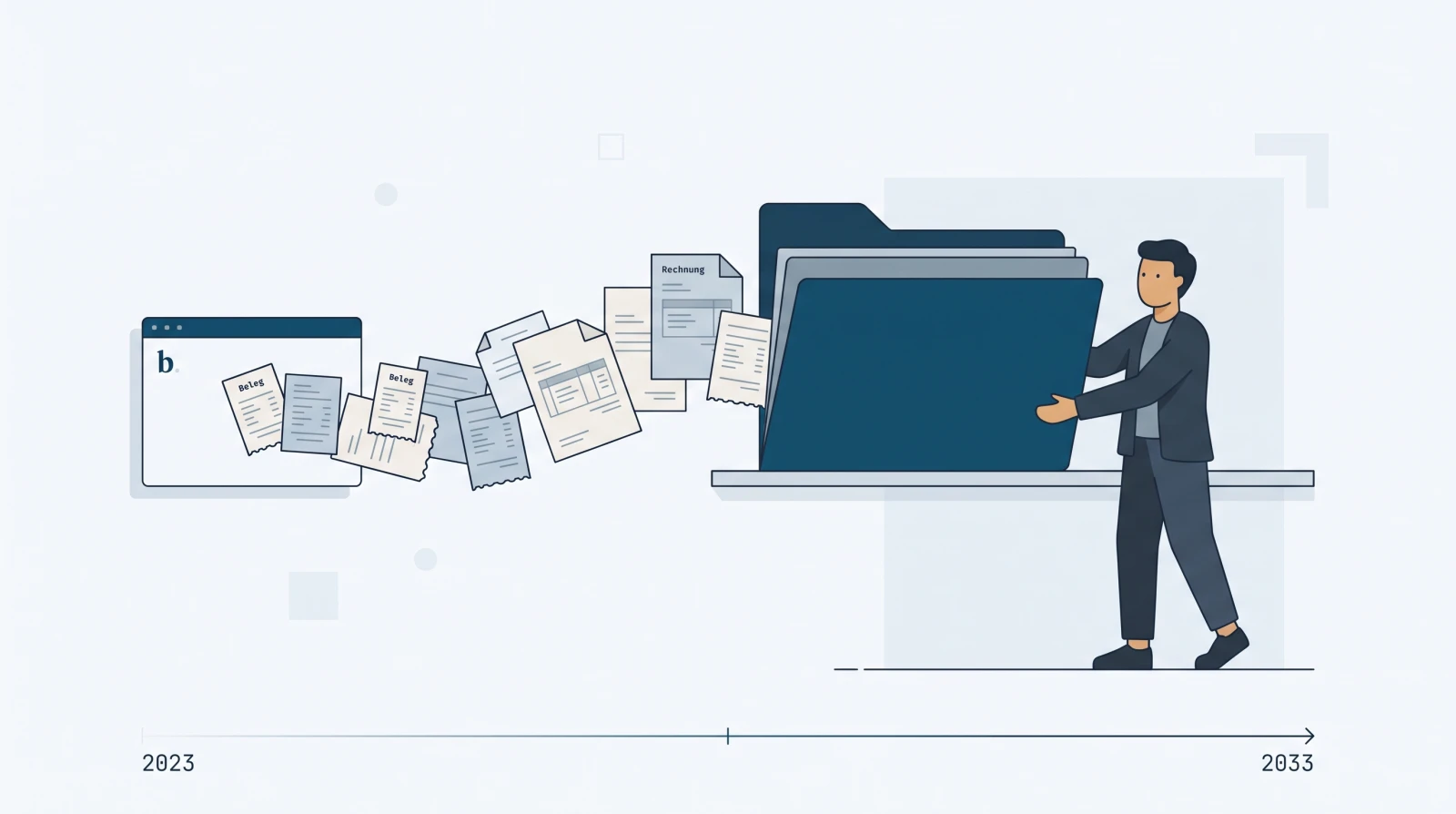
As of: July 2026 · This article is not legal advice.
How long must documents be retained in Switzerland? Books of account, accounting vouchers, and the annual and audit report: 10 years from the end of the financial year (Art. 958f CO). Documents relating to immovable property (real estate): 20 years (Art. 70 para. 3 VAT Act). You may retain records digitally — paper is not necessary in almost all cases. Only the annual and audit report need a signature.
This guide answers the three questions every tax audit hinges on: who must retain records, what exactly, and for how long — plus the practical part most guides leave out: how to solve this digitally and in a GeBüV-compliant way, so an audit never catches you cold.
Retention periods in Switzerland: the table

| Document | Retention period | Form | Legal basis |
|---|---|---|---|
| Books of account (general ledger, journals) | 10 years | Paper or electronic | Art. 958f para. 1+3 CO |
| Accounting vouchers (invoices, receipts; contracts and correspondence, insofar as they substantiate an entry) | 10 years | Paper or electronic | Art. 958f CO; FTA VAT Info 16 |
| Annual report (financial statements) and audit report | 10 years | Signed — on paper or electronically with a qualified electronic signature (QES) | Art. 958f para. 2 CO |
| Documents relating to immovable property (purchase contracts, construction-cost statements, associated invoices) | 20 years — thereafter until the tax limitation period is reached | Paper or electronic | Art. 70 para. 3 VAT Act; FTA VAT Info 16 no. 1.6.2 |
| VAT-relevant documents in general | Until the absolute limitation of the tax claim | Paper or electronic | Art. 70 para. 2 in conjunction with Art. 42 para. 6 VAT Act |
| After liquidation of a company | 10 years from deregistration | In a safe place | Art. 747 CO |
| Private individuals | No general statutory obligation (recommended: until the tax assessment is legally final) | — | — |
For a single document type, the retention period calculator works out the end date per document year — under Swiss law, not under the German 6/8-year rules.
The periods run per financial year — which is why a filing system that makes the year the load-bearing folder level pays off (the template for that). The how of digital retention — integrity, traceability, availability — is governed by the GeBüV; it is explained in detail here.
Who is required to retain records?

Subject to the retention obligation is anyone required to keep accounts under the Swiss Code of Obligations (Art. 957 para. 1 CO): legal entities (GmbH, AG, cooperative) as well as sole proprietorships and partnerships with CHF 500,000 or more in revenue in the last financial year.
Anyone below that threshold only keeps simplified accounts “of income and expenditure and of the asset position” (Art. 957 para. 2 CO) — but must still retain records: tax law expressly requires the self-employed and legal entities to keep records and vouchers for 10 years (Art. 126 para. 3 DBG). The 10-year obligation therefore hits practically every business, regardless of size.
Which documents must you retain?
Not “everything”, but more than many think. Subject to retention are:
- Books of account — the general ledger and journals, i.e. the bookkeeping itself.
- Accounting vouchers — every voucher that supports an entry: supplier and customer invoices, receipts, cash-register slips, bank and credit-card statements, payslips, expense receipts.
- Annual and audit report — the financial statements including the notes; for companies subject to audit, the audit report as well.
- Contracts and correspondence, insofar as they substantiate an entry — the lease behind the rent-expense entry, the order confirmation behind the customer invoice.
The practical rule of thumb: if a document explains why a figure sits in the books, it is an accounting voucher — and therefore subject to 10 years’ retention. “No entry without a voucher” also applies in reverse.
When does the period start to run?
The period runs from the end of the financial year, not from the document date (Art. 958f para. 1 CO): an invoice from March 2026 belongs to the 2026 financial year and must remain available until the end of 2036. Under VAT law, retention generally runs until the absolute limitation of the tax claim (Art. 70 para. 2 in conjunction with Art. 42 para. 6 VAT Act) — which can easily extend beyond the end of the CO period. When in doubt, the longer period applies.
Paper or digital? Digital is enough
You may keep your records digitally — the GeBüV expressly permits electronic archiving, provided integrity, traceability and availability are ensured. Paper originals may in most cases be disposed of after scanning; the few exceptions (signed reports, certain deeds) are manageable. How digital retention must look in concrete terms — the two permitted routes under Art. 9 GeBüV and the one-page process documentation — is set out in the GeBüV guide.
Is Google Drive GeBüV-compliant for retention?
Google Drive meets the technical requirements for keeping digital receipts in an audit-proof way, compliant with the CO, GeBüV and tax law. SECO’s SME portal classifies cloud storage as alterable data media subject to the “stricter requirements” (kmu.admin.ch) — exactly these requirements (integrity protection, provable storage time, logs) are what Google Drive covers technically.
Two clarifications no vendor likes to mention:
- Audit-proof record keeping is not a product feature — it results from the system plus its orderly use: the process documentation (Art. 4 GeBüV) and the annual legibility check (Art. 10) remain your task (our fiduciary’s assessment).
- A state “GeBüV certification” does not exist. Compliance always remains the company’s responsibility; product certificates (such as from the KRM testing body) are private-sector audits, not an official approval.
For the retention obligation this means in practice: your records sit in the accounting system (with bexio, for example, in the inbox or — from Optima up — in the Document Archive), and a continuous, complete second copy in your own Google Drive covers loss protection (Art. 5), findability via OCR full-text search (Art. 6) and exit security. The 10-year obligation does not end with your software subscription — there is no self-service full export at bexio, and bexio itself recommends “additionally keeping the records outside of bexio in each case” (help article 000001647).
What happens in the event of a violation?
The retention obligation is not a mere formality:
- Fine: Anyone who fails to comply with the obligation to properly keep and retain the books of account commits a punishable contravention (Art. 325 StGB).
- Discretionary assessment: If reliable documents are missing, the FTA and the assessment authority estimate the tax “at their dutiful discretion” (Art. 79 VAT Act; Art. 130 para. 2 DBG) — challengeable only “on grounds of manifest inaccuracy” (Art. 132 para. 3 DBG).
- Input VAT deduction: No voucher, no proof — the deduction can be refused.
- Evidentiary disadvantages: In a civil dispute, the evidence is simply missing.
Checklist: record retention for Swiss SMEs

- Capture all records digitally (scan or PDF original) — paper can then be disposed of in most cases (exceptions).
- Retain the annual report and audit report signed — on paper or electronically with a qualified electronic signature (QES).
- Assign records to a system (accounting software), do not collect them in loose folders.
- Create a one-page process documentation (Art. 4 GeBüV — template in the GeBüV guide).
- Keep an automatic second copy outside the system — your own Drive, your own storage, your own control.
- Keep deletion periods under control: dispose of nothing before the 10 years are up; for real-estate documents, 20 years and until the tax limitation period.
- Test once a year: can you find any record from three years ago in under a minute — and is it still legible (Art. 10)?
Frequently asked questions (FAQ)
How long must business records be retained in Switzerland? Books of account, accounting vouchers, and the annual and audit report: 10 years from the end of the financial year (Art. 958f CO). Documents relating to immovable property: 20 years (Art. 70 para. 3 VAT Act), and correspondingly longer where the tax limitation period is still running.
Which documents must be retained for 10 years? The general ledger and journals, all accounting vouchers (invoices, receipts, contracts and correspondence, insofar as they substantiate entries), and the annual and audit report.
When does the retention period start to run? From the end of the financial year, not from the document date. An invoice from March 2026 belongs to the 2026 financial year and must be retained until the end of 2036.
Do I have to keep receipts in paper form? Usually no — digital retention is permitted under the GeBüV. Exceptions are signed reports and certain deeds (details).
Does the retention obligation also apply to private individuals? No — the 10-year obligation applies to businesses. Private individuals are well advised to keep tax records until the assessment is legally final, and real-estate documents considerably longer.
Is storage in the cloud (Google Drive) GeBüV-compliant? Yes — under the conditions of Art. 9 para. 1 let. b GeBüV (integrity protection, provable storage time, documentation, logs). Google Drive meets these technical conditions; the process documentation and the annual check remain with the company (our assessment).
Is storing records in the accounting software enough? Organizationally, usually yes — but loss protection and exit security are missing when the only copy sits with the software provider and is deleted after the contract ends (with bexio: one month after cancellation, GTC no. 5.7).
quintio.ch continuously mirrors all documents from bexio into your own Google Drive — searchable, with OCR, effortless. Your second copy for the next 10 years.
Sources
- Art. 957 / 957a / 958f CO (SR 220, Fedlex)
- GeBüV — Ordinance on the Keeping and Preservation of Business Records (SR 221.431, Fedlex)
- Art. 70 VAT Act (SR 641.20, Fedlex) · Art. 126 DBG (SR 642.11) · Art. 325 StGB
- SECO SME portal: Electronic retention of business books (as of 11 Dec 2025)
- FTA: VAT Info 16 — Accounting and Invoicing, no. 1.6
- bexio help article 000001647 (retention outside bexio)
quintio automatically mirrors your bexio documents into your own Google Drive.
Sign up free